8 results ·
● Live web index

E
energyencyclopedia.com
article
https://www.energyencyclopedia.com/en/nuclear-fusion/thermonuclear-fusion-pow…
The power plant must produce all the tritium that it needs as fuel. Another challenge is divertor construction and materials used. With a fusion power output of 1,000 MW or even higher, the heat load that the divertor must remove will be enormous. There is a large experience in divertor designing, manufacturing, and installing, but with increasing machine size and heat load, new challenges arise. For successful power plant operation, the steady-state is necessary, but for the tokamak type of reactor, the question is still open whether it will be reached. Some of the DEMO projects work with the possibility that, at least in the early phases, the steady-state regime will not be achieved, and the reactor will be able to operate only in long pulses. Theoretical calculations for many DEMO projects show that their reactor will be able to reach a non-inductive steady-state regime and keep it as long as possible, but only experiments can prove this theory.

O
osti.gov
official
https://www.osti.gov/servlets/purl/1474727
This paper presents a preliminary evaluation of the materials challenges presented by the conceptual design [1] for a Fusion Nuclear Science Facility (FNSF) to

K
knowablemagazine.org
article
https://knowablemagazine.org/content/article/physical-world/2023/the-challeng…
The ultimate goal is to get the plasma past the temperature of “ignition,” which is when fusion reactions will start to generate enough internal energy to make up for that radiating away of energy — and power a city or two besides. A fusion power plant could use one of several different reactor types, but it will turn fusion energy into electricity the same way that fossil-fuel power plants or nuclear-fission reactors do: Heat from the energy source will boil water to make steam, the steam will flow through a steam turbine, and the turbine will turn an electric generator to send power into the grid. But ITER was also designed as a research machine with a lot more instrumentation and versatility than a working power reactor would ever need — which is why two of today’s best-funded fusion startups are racing to develop tokamak reactors that would be a lot smaller, simpler and cheaper.

I
iaea.org
article
https://www.iaea.org/bulletin/what-is-fusion-and-why-is-it-so-difficult-to-ac…
The sun, along with all other stars, is powered by a reaction called nuclear fusion. Today, we know that the sun, along with all other stars, is powered by a reaction called nuclear fusion. The amount of energy produced from fusion is very large — four times as much as nuclear fission reactions — and fusion reactions can be the basis of future fusion power reactors. On earth, we need temperatures exceeding 100 million degrees Celsius and intense pressure to make deuterium and tritium fuse, and sufficient confinement to hold the plasma and maintain the fusion reaction long enough for a net power gain, i.e. the ratio of the fusion power produced to the power used to heat the plasma. At the second United Nations International Conference on the Peaceful Uses of Atomic Energy, held in 1958 in Geneva, Switzerland, scientists unveiled nuclear fusion research to the world. The first international IAEA Fusion Energy Conference was held in 1961 and, since 1974, the IAEA convenes a conference every two years to foster discussion on developments and achievements in the field.

N
news.utexas.edu
research
https://news.utexas.edu/2025/05/05/university-of-texas-led-team-solves-a-big-…
AUSTIN, Texas — Abundant, low-cost, clean energy — the envisioned result if scientists and engineers can successfully produce a reliable method of generating and sustaining fusion energy — took one step closer to reality, as a team of researchers from The University of Texas at Austin, Los Alamos National Laboratory and Type One Energy Group solved a longstanding problem in the field. To prevent them from leaking, engineers design elaborate magnetic confinement systems, but there are often holes in the magnetic field, and a tremendous amount of computational time is required to predict their locations and eliminate them. In their paper published in Physical Review Letters, the research team describes having discovered a shortcut that can help engineers design leak-proof magnetic confinement systems 10 times as fast as the gold standard method, without sacrificing accuracy. A stellarator uses external coils carrying electric currents that generate magnetic fields to confine a plasma and high-energy particles. This new method also can help with a similar but different problem in another popular magnetic fusion reactor design called a tokamak.

R
reddit.com
article
https://www.reddit.com/r/fusion/comments/1kr9zc4/what_are_fusions_unsolved_en…
There are dozens of unstated engineering problems that need to be solved before fusion can be commercially successful at scale.

K
kleinmanenergy.upenn.edu
research
https://kleinmanenergy.upenn.edu/research/publications/bringing-fusion-energy…
[Skip to Content](https://kleinmanenergy.upenn.edu/research/publications/bringing-fusion-energy-to-the-grid-challenges-and-pathways/#content). [Download PDF](https://kleinmanenergy.upenn.edu/wp-content/uploads/2025/10/KC-Digest-81-Bringing-Fusion-Energy-to-the-Grid.pdf). ](https://kleinmanenergy.upenn.edu/wp-content/plugins/a3-lazy-load/assets/images/lazy_placeholder.gif)](https://kleinmanenergy.upenn.edu/wp-content/uploads/2025/09/Fig-3.jpg)[](https://kleinmanenergy.upenn.edu/wp-content/uploads/2025/10/Fig-4.jpg). This category has over $2.5 billion in funding and 15 startups, such as TAE Technologies, Helion, and General Fusion.](https://kleinmanenergy.upenn.edu/wp-content/plugins/a3-lazy-load/assets/images/lazy_placeholder.gif)](https://kleinmanenergy.upenn.edu/wp-content/uploads/2025/10/Table-1-4.jpg). Historically, facilities like the [UR-LLE National Laser Users’ Facility](https://www.lle.rochester.edu/about-the-laboratory-for-laser-energetics/nluf/) (NLUF) program, the [DIII-D National Fusion Facility](https://science.osti.gov/fes/Facilities/User-Facilities/DIII-D), and Princeton’s [National Spherical Torus Experiment](https://science.osti.gov/fes/Facilities/User-Facilities/NSTX-U) have enabled hundreds of users to conduct experiments not possible at their home institutions, diffusing knowledge while harnessing national scientific ingenuity (U.S. Department of Energy 2024). “Promoting Fusion Energy Leadership with U.S. Tritium Production Capacity.” [_https://fas.org/publication/fusion-energy-leadership-tritium-capacity/_](https://fas.org/publication/fusion-energy-leadership-tritium-capacity/). “Major Funding Milestone for World-First Prototype Fusion Plant.” [_https://www.gov.uk/government/news/25-billion-for-world-first-prototype-fusion-energy-plant_](https://www.gov.uk/government/news/25-billion-for-world-first-prototype-fusion-energy-plant). “U.S. Department of Energy Announces Selectees for $107 Million Fusion Innovation Research Engine Collaboratives, and Progress in Milestone Program Inspired by NASA.” _[https://www.energy.gov/articles/us-department-energy-announces-selectees-107-million-fusion-innovation-research-engine](https://www.energy.gov/articles/us-department-energy-announces-selectees-107-million-fusion-innovation-research-engine)_. [More…](https://kleinmanenergy.upenn.edu/research/publications/bringing-fusion-energy-to-the-grid-challenges-and-pathways/#addtoany "Show all").

I
iter.org
article
https://www.iter.org/fusion-energy/making-it-work
* [FAQs](https://www.iter.org/node/12007). * [Subscribe](https://www.iter.org/fusion-energy/making-it-work#) ## Subscribe to the newsletter. * [FAQs](https://www.iter.org/node/12007). * [Fusion Energy](https://www.iter.org/fusion-energy/what-fusion "Bringing a star to Earth? * [What is Fusion?](https://www.iter.org/fusion-energy/what-fusion). * [Making it Work](https://www.iter.org/fusion-energy/making-it-work). * [Advantages of Fusion](https://www.iter.org/fusion-energy/advantages-fusion). * [60 Years of Progress](https://www.iter.org/fusion-energy/60-years-progress). * [ITER Goals](https://www.iter.org/fusion-energy/what-will-iter-do). * [International Tokamak Research](https://www.iter.org/fusion-energy/international-tokamak-research). * [After ITER](https://www.iter.org/fusion-energy/after-iter). * [Fusion Glossary](https://www.iter.org/fusion-glossary). * [What is a Tokamak?](https://www.iter.org/machine/what-tokamak). * [FAQs](https://www.iter.org/node/12007). * [Education](https://www.iter.org/public/education/join-quest-fusion-energy). * [Fusion Glossary](https://www.iter.org/fusion-glossary). * [Conferences](https://www.iter.org/node/9967). * [FAQs](https://www.iter.org/node/12007). * [Subscribe](https://www.iter.org/fusion-energy/making-it-work#) ## Subscribe to the newsletter. [](https://www.iter.org/search). In ITER, fusion will be achieved in a[tokamak](https://www.iter.org/mach/Tokamak)device that uses magnetic fields to contain and control the hot plasma. 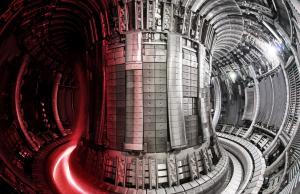. [Fusion | Turning neutrons into electricity](https://www.iter.org/node/20687/turning-neutrons-electricity). Not without control engineering](https://www.iter.org/node/20687/sustained-nuclear-fusion-not-without-control-engineering). [Why "plasma"?](https://www.iter.org/node/20687/why-plasma). ](https://www.iter.org/fusion-energy/what-fusion). ](https://www.iter.org/sites/default/files/styles/responsive_300w/public/media/2024-02/t1_1_no-caption.jpg.webp?itok=pfS50jWf)](https://www.iter.org/fusion-energy/60-years-progress). Image générée par ordinateur.](https://www.iter.org/sites/default/files/styles/responsive_300w/public/media/2024-02/poster-2016-27-09-2023-edit-2_no-logo.jpg.webp?itok=4wnnp18h)](https://www.iter.org/fusion-energy/what-will-iter-do). * [FAQs](https://www.iter.org/node/12007). * [Fusion Energy](https://www.iter.org/fusion-energy/what-fusion "Bringing a star to Earth? * [What is Fusion?](https://www.iter.org/fusion-energy/what-fusion). * [Making it Work](https://www.iter.org/fusion-energy/making-it-work). * [Advantages of Fusion](https://www.iter.org/fusion-energy/advantages-fusion). * [60 Years of Progress](https://www.iter.org/fusion-energy/60-years-progress). * [ITER Goals](https://www.iter.org/fusion-energy/what-will-iter-do). * [International Tokamak Research](https://www.iter.org/fusion-energy/international-tokamak-research). * [After ITER](https://www.iter.org/fusion-energy/after-iter). * [Fusion Glossary](https://www.iter.org/fusion-glossary). * [FAQs](https://www.iter.org/node/12007). * [Education](https://www.iter.org/public/education/join-quest-fusion-energy). * [Fusion Glossary](https://www.iter.org/fusion-glossary). * [Conferences](https://www.iter.org/node/9967).